
Alleghany County VINELink Coverage
NC SAVAN electronically links all North Carolina jails with Adult Correction information for prisons, probation, and parole. That makes it relevant to a person booked at the Alleghany County Detention Center and to a person whose custody later moves into the North Carolina Department of Adult Correction. VINELink is the public search and registration route for participating records. It is an event-notification service, not Alleghany County's missing recent-release list and not a permanent archive of every prior jail event.
System boundaries matter. NC SAVAN does not monitor police holding cells, juvenile facilities, or mental facilities. A person who posts bond at the magistrate stage without being booked into the county jail may never enter the service. A county record also differs from a DAC record. The local booking number and state offender number are not interchangeable, and a cross-housed person can have both. Search and register against the record held by the agency responsible at that stage.
Note: A missing VINELink result is not proof of release because a covered booking may not exist or a feed may not have updated.
Search One Alleghany County Inmate
Begin with the correct state and enough identity information to avoid a false match. Alleghany County, North Carolina can easily be confused with Alleghany Regional Jail in Virginia or facilities in states that spell Allegany without the second “h.” The reporting agency is therefore as important as the name. The Alleghany County released-inmate search path explains the broader records fallback when VINELink does not return the person.
- Open VINELink and select North Carolina.
- Choose the custody or offender search offered for the participating agency.
- Enter the full name or the offender or booking identifier associated with that agency.
- Use a spelling alternative only if the first careful search produces no match.
- Compare age or date of birth, the reporting agency, and any displayed identifier.
- Open the matching record and read the current reported status, location, and event date.
- Confirm a release result with the agency named in that record.
A common name can produce several people or several records for one person. Do not merge them. An Alleghany jail entry may describe a local booking while a DAC entry describes prison or community supervision. If the result says the person is still held, the named location identifies the system to contact. If it reports release, record the agency and supplied event date before seeking the actual release summary.
The VINELink person-search interface is the official public starting point shown below.
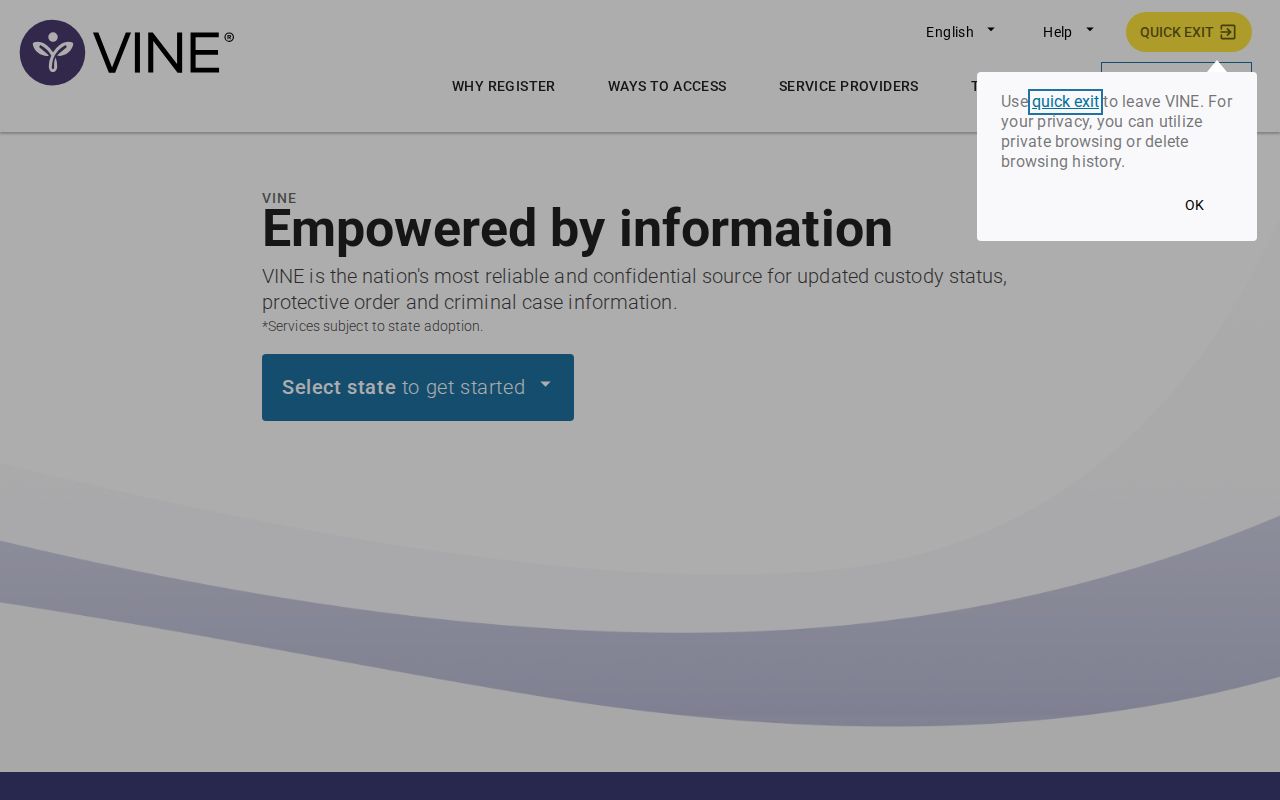
The interface starts the identity check, while the reporting jail or DAC office remains the source for a final release record.
Alleghany VINELink Release Fields
The fields depend on the agency feed and the current interface. Official static guidance does not promise one permanent label set for every released result. The accurate reading is narrower: a returned record communicates a current reported custody or status event and may reflect release or another custody change. It should not be assumed to include the reason, destination, court disposition, photograph, or an enduring release-history entry.
| Result element | What it supports | What it does not prove |
|---|---|---|
| Name and identifier | Which agency record was selected | Identity without comparing other details |
| Reporting agency | Which jail or correction system supplied the event | That every other custody system was checked |
| Custody or status | The agency's currently reported state | A complete historic release archive |
| Location | The place or agency shown by the feed | Community release after a transfer |
| Event date | The date attached to the reported change | The full legal reason or exact release record |
| Notification options | Which delivery channels are offered for that record | That every future event will be available |
For a person still at the Alleghany County Detention Center, current custody and an offered alert can be useful. For a person already reported out of custody, call Detention at 336-372-6233 and seek the Records Unit entry or release summary at 336-372-4455. For a DAC case, compare OPI status, last movement type and date, and supervision status. A projected state date is not an accomplished release.
Register Alleghany Release Alerts
Registration attaches a notification choice to a specific record. Depending on the agency and current configuration, the interface may offer telephone, text, email, or an app or account channel. Choose only what the live result presents. Telephone registration uses a memorable four-digit PIN. That PIN confirms receipt and protects alert management, so it should be retained privately.
- Open the correctly matched individual record.
- Select the offered release, transfer, or custody-status event.
- Choose one of the contact channels displayed for that record.
- Enter and confirm the contact information requested by the service.
- Create and retain the four-digit PIN when telephone notice is selected.
- Acknowledge calls or alerts as instructed by NC SAVAN.
- Contact the custodian if an expected alert does not arrive.
The official NC SAVAN hotline, 1-877-NC-SAVAN (1-877-627-2826), provides automated status and registration around the clock. Registration is anonymous, and the person in custody is not told who registered. If a PIN is forgotten, the official instruction is to call the hotline and press 0. These safeguards apply to the registration, not to the separate task of getting a release record from Alleghany County or DAC.
Note: Never treat silence from an alert channel as proof that Alleghany County custody continued or ended.
NC SAVAN Alert Timing
North Carolina publishes meaningful timing rules for telephone and email notices. Ordinary phone notifications generally occur from 8:00 a.m. to 8:00 p.m. Critical release, escape, and capture calls can arrive at any time. An unanswered critical call can repeat every 30 minutes for 24 hours. Other unanswered calls repeat every two hours during calling hours for 24 hours. Email sends one status-change message at any time.
Those rules explain how notice is attempted, not how fast the Alleghany jail or DAC feed posts the underlying event. No fixed local lag is published. The safest practice is to note when the alert arrived, preserve the agency name, and verify the event directly. A phone status is current only when supplied. A written jail release summary or DAC movement entry is the more durable evidence of what happened.
Telephone calls continue until the registered four-digit PIN is entered. That behavior can help distinguish an unacknowledged automated notice from a completed confirmation. Critical-event repetition does not mean several releases occurred; it is the service retrying one alert. Ordinary unanswered calls follow the slower schedule within calling hours, while email sends one message. A user who changes a phone number or email address should return to the registration channel rather than assume the old contact follows the person automatically.
Alleghany Transfer Alerts Need Re-registration
This local notification layer is especially important when someone leaves the Alleghany County Detention Center through a transfer. A transfer notice is not a community-release notice. If DAC picks up a sentenced prisoner, the person has left the Sparta jail but remains in custody. NC SAVAN explains that the user may need to call and register again after a transfer so that later events from the receiving agency are covered.
The identifier change is practical, not merely technical. The county jail can hold a local booking ID while DAC assigns a state offender number. A temporarily cross-housed person may have both. Registering only the county record can leave the later state stage uncovered. Search the receiving system, compare identity carefully, then create a registration for the state record. Confirm the eventual release with the agency that reports it.
NC SAVAN also does not issue parole-review notices. Commission or Victim Support registration is a distinct channel. The service can show probation or parole data within its coverage, yet it should not be used as a substitute for the North Carolina Post-Release Supervision and Parole Commission's case process.
The all-jails description also has a booking boundary. A police precinct or local police holding cell is outside NC SAVAN, as are juvenile and mental facilities. Someone who satisfies bond at the magistrate stage and never enters the Alleghany County Detention Center may have no jail record for the service to report. When a careful name and identifier search returns nothing, check whether a covered booking actually occurred. A no-result can also reflect different spelling, an update in progress, or movement to another agency record.
That is why a fresh registration follows the receiving record. After DAC pickup, search OPI for the state offender number, compare the admission and location, and then use the notification option connected to that state identity. After a return to another county, use the receiving jail's record. This method keeps the Alleghany County departure distinct from the later custody event and reduces the chance that a transfer alert is reported as final release.
Confirm an Alleghany VINELink Release
VINELink does not serve as the federal Bureau of Prisons locator. A federal prisoner must be searched through the official BOP system, while immigration custody uses ICE's separate locator. It also cannot establish that release from an Alleghany charge meant freedom from every hold. Another county, DAC, federal authorities, or immigration authorities may continue custody after the local jail closes its part of the event.
Verification limit. Treat a VINELink event as a prompt to contact the named custodian. Do not infer a release reason, destination, or final discharge from the alert alone.
Use the Alleghany County Detention Center for a local jail event, the Sheriff's Records Unit for the release summary, and the court case for the order or disposition. Use NC DAC OPI when a state sentence or supervision record is involved. A released county detainee, a transferred state prisoner, and a former federal prisoner occupy different systems. Keeping those systems separate is the most reliable way to make one VINELink release check useful.
For a federal sentence, the BOP Inmate Locator is the correct official channel. It can show a release date and a “RELEASED” location for many former federal prisoners, but that means only that the person is no longer in BOP custody. For suspected immigration custody, the ICE Online Detainee Locator uses an A-number and country of birth or biographical details. Neither result should be folded into an Alleghany County VINELink record. Each authority must confirm its own custody stage.
The same discipline applies to state supervision and the local court. NC SAVAN can carry prison, probation, and parole data, yet an Active Probationer-Parolee status describes community supervision rather than full discharge. The Judicial District 34 case may show the order or sentence behind a local release, but not the exact minute jail processing ended. An alert, court event, and facility movement answer different parts of the question. Together, when identities and agencies match, they form a stronger Alleghany County release check.