
Alleghany Release Date Meanings
A projected release date is a calculation, not proof that the person has left. NC DAC calls its public estimate “Projected Release Date.” Its release procedures also use PRD or “max out” for expiration of sentence, meaning complete service without parole or post-release-supervision reporting. The same policy recognizes other paths, including a court order, safekeeper return, diagnostic release, interstate compact release, pardon, commutation, and time served. The label must be read with the sentence and current status.
An actual release is a completed movement. In a DAC record, current status plus last movement type and date can help confirm it. At the Alleghany County Detention Center, the Sheriff’s entry or release summary supplies the actual date and time. A court order may authorize release before jail staff finish processing. It can also coexist with another hold. A departure from the Sparta jail may be a transfer to DAC, another county, federal custody, or immigration custody rather than return to the community.
Scheduled versus actual. Label every future date as projected. Confirm the completed event through the facility record, movement history, and current custody status.
Choose the Alleghany Release Source
The first task is identifying the custody system. NC DAC’s public search expressly excludes county-jail data. A person booked and released only by Alleghany County may never appear there. Conversely, a DAC record showing Alleghany as the county of conviction does not mean the state prisoner was held or released at 40 Alleghany Street. Federal and immigration systems have separate locators and calculations.
| Situation | Best date source | Key limit |
|---|---|---|
| Pretrial Alleghany detainee | Current jail status and court release conditions | No sentenced release date exists while the case and bond remain unresolved |
| Sentenced local jail prisoner | Detention or Records Unit and the judgment | Authorized local credits must be applied by the custodian |
| Sentenced DAC prisoner | OPI Projected Release Date and sentence fields | The date can change and does not prove actual movement |
| Person moved into supervision | DAC status, last movement, and PRS or parole status | Out of prison is not full sentence discharge |
| Former federal prisoner | BOP Inmate Locator | BOP data does not confirm an Alleghany County jail release |
The Alleghany County release-record guide gives the named-person fallback across jail, court, state, federal, and immigration channels. For a date question, stay with the system that imposed and administers the relevant custody.
Find an Alleghany Inmate Release Date
For a state-prison sentence, the NC DAC Offender Public Information record has the richest public field set. Its search statuses are All, Active Inmate, Active Probationer-Parolee, and Inactive. A person who left prison but remains under supervision may be Active Probationer-Parolee rather than Inactive. Open the detail instead of stopping at a result list.
- Identify whether the person is in the Alleghany jail, DAC, or another system.
- For DAC, open Offender Public Information and choose the status that fits, or All when uncertain.
- Search by DAC offender number when known; otherwise use name with enough identity filters to separate matches.
- Compare county of conviction, admission, sentence number, commitment type, and current status.
- Read the Projected Release Date, then check last movement type and date and supervision status.
- For a local sentence, call Alleghany Detention at 336-372-6233 and Records at 336-372-4455, then compare the judgment.
- Date-stamp the answer and confirm again near the expected event.
The dedicated NC DAC Inmate Release Search supplies a released-first route by surname or release county, year, and month. It also includes choices for an unreported release county or release to another state. Its “release county” remains a DAC field. It is not a recent-release list for the Alleghany County Detention Center.
Note: A projected date standing alone carries less weight than a matching status, sentence, and actual last-movement entry.
North Carolina Minimum-Term Rule
North Carolina does not use a sound one-size “85 percent” rule for this calculation. For covered felony offenses committed on or after October 1, 1994, Structured Sentencing applies under G.S. 15A-1340.10. G.S. 15A-1340.13(d) requires service of the minimum term. DAC explains that a felony prisoner serves the full judicial minimum, with judge-ordered jail credit counting. Earned time may reduce the maximum toward that minimum but not below it.
Older Fair Sentencing cases can follow different rules involving gain time, day-for-day good time subject to forfeiture, merit time, and parole. Offense date and judgment therefore matter. A news account that states only a maximum term does not supply enough information to calculate the date. The public record, DAC calculation, and controlling sentence should be used rather than independent arithmetic.
The official felony minimum-service statute is shown below.
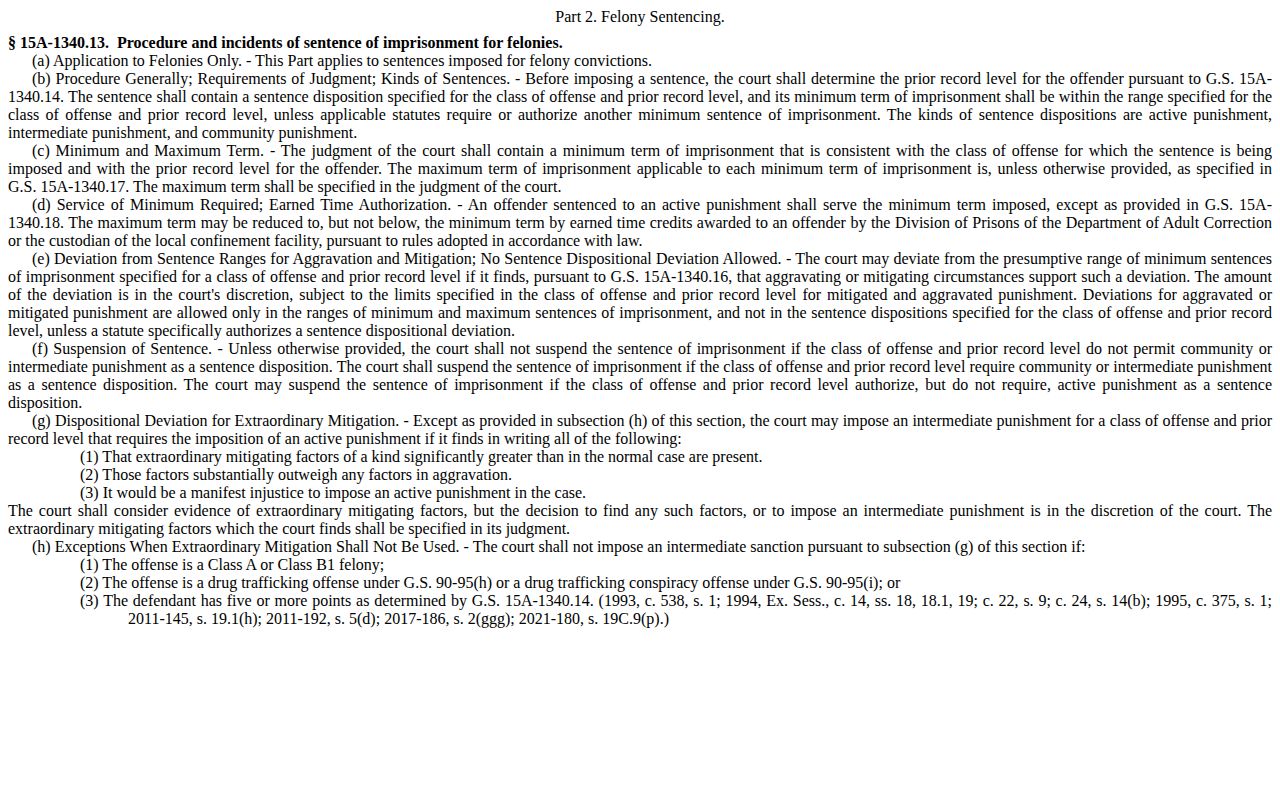
The statute anchors why a projected maximum may move while the judicial minimum remains the floor for the covered felony sentence.
Alleghany County Release Mechanisms
A single future date cannot describe every lawful exit. NC DAC Policy Q.0100 distinguishes expiration of sentence from court-ordered release, safekeeper return, diagnostic release, interstate compact release, pardon, and commutation or time served. Some mechanisms end confinement, while others change the place or legal basis of custody. The record must name the event before the date can be described accurately.
Alleghany County presents the same distinction at the jail level. A pretrial detainee may leave after satisfying release conditions, dismissal, or another court order. A sentenced local prisoner may leave after time served and authorized credits. A person can also depart the Sparta building through DAC pickup, return to another county, a writ, or delivery to federal or immigration authorities. Those transfers end the Alleghany County Detention Center's physical hold but do not establish release to the community.
When a projected date approaches, ask the current custodian which release mechanism is expected and whether another hold is recorded. Do not infer it from the date alone. A state PRD tied to expiration differs from movement into post-release supervision, and both differ from a transfer. The actual movement entry, release summary, and receiving-agency record resolve that difference after the event.
Alleghany Jail Credit Rules
Local sentenced prisoners also have a legal credit framework, but it does not create a public online date calculator. G.S. 148-13 directs DAC to establish earned-time rates and circumstances and distribute those rules to local jail administrators. G.S. 15A-1355 addresses sentence calculation, jail credit, and earned credit. The Alleghany custodian applies the rules to its sentenced prisoner and should confirm the resulting date.
For misdemeanors, G.S. 15A-1340.20 says each day is served apart from authorized credits and caps combined earned credit at four days per month. That rule belongs only to a sentenced case. It cannot estimate when a pretrial detainee will post bond, receive a court order, or clear another hold.
North Carolina's calculation and credit statute illustrates the source that must be read with the judgment.
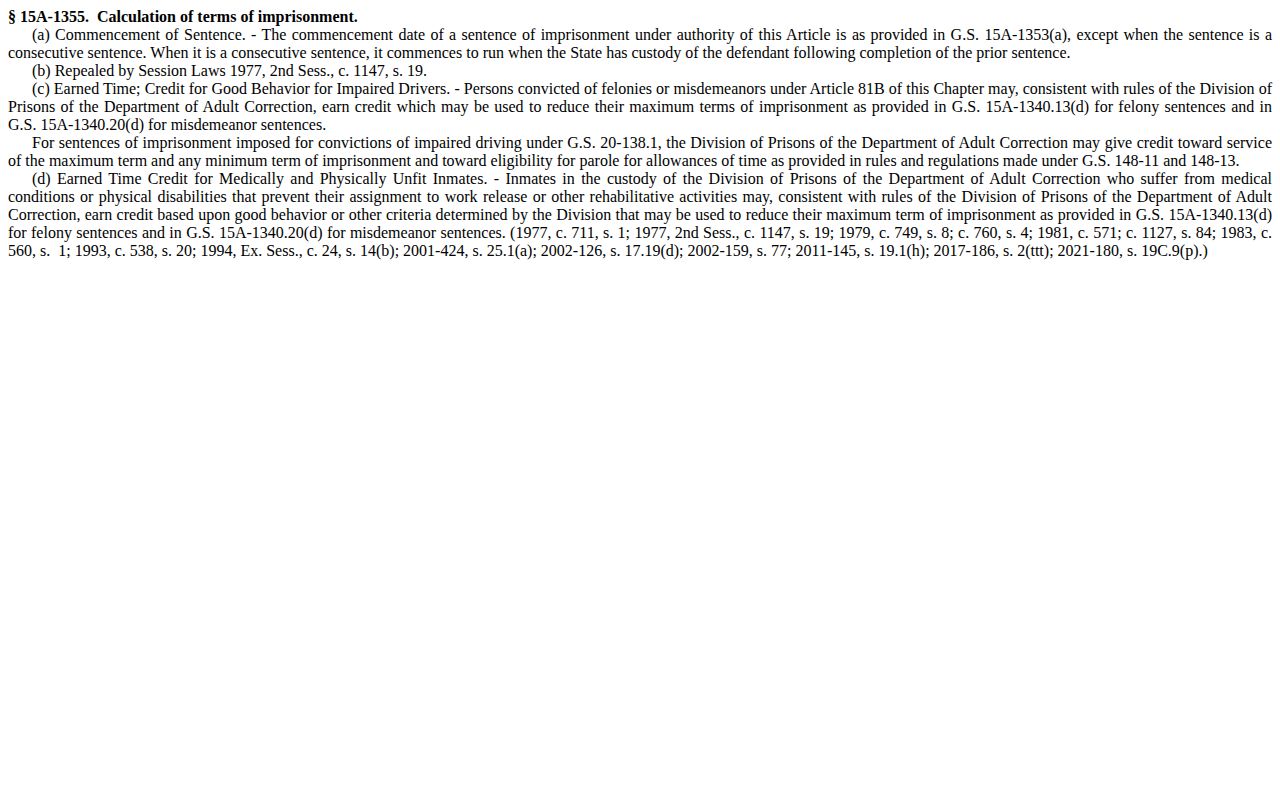
The legal framework informs the jail’s work, but only the facility and court record can resolve the person-specific Alleghany calculation.
Why Alleghany Release Dates Change
A date can move for more than one reason, and the source determines which change is visible. State OPI may update a calculated field after DAC action. A county sentence may require a corrected judgment or credit calculation. An apparent local release can instead become a transfer when another authority assumes custody.
| Change | Possible effect | Where to verify |
|---|---|---|
| Earned-time accrual or loss | Moves the calculated maximum within lawful limits | DAC or local custodian |
| Assignment, program, or discipline | Changes credit treatment under applicable rules | DAC sentence record |
| Jail-credit correction | Adjusts time already credited to the term | Judgment and custodian calculation |
| Sentence aggregation | Changes how multiple terms produce a controlling date | DAC sentence history |
| Vacatur, resentencing, or new judgment | Replaces or alters the legal sentence | Alleghany court case and DAC |
| Legacy parole action | Can alter the route or timing in an eligible older case | Parole Commission and OPI |
| Another agency hold | Ends one custody stage without community release | Releasing and receiving agencies |
A transfer from the Alleghany jail to DAC changes who can answer the date question. A qualifying federal or immigration hold can do the same. The court record may explain the release authority but may not show the exact time physical processing ended. Use the newest record from the agency presently responsible.
Sentence aggregation deserves special care. A person may have more than one sentence number, commitment type, or county of conviction in OPI. The date attached to one line may not be the controlling date for the full period of custody. Review total term, admission history, current and prior locations, and each sentence entry before reading the projected field. DAC remains the source for how those terms combine. The Alleghany court file can explain its own judgment but cannot calculate unrelated state judgments from other counties.
Legacy parole can also change the path without creating a routine rule for modern cases. Structured Sentencing generally replaced discretionary parole for covered offenses with post-release supervision. Parole still can matter for eligible older or special-category sentences. An approval by the Post-Release Supervision and Parole Commission is prospective authority, not proof that DAC executed the movement. Confirm the actual release through OPI status and last movement rather than treating a decision date as the prison exit date.
Confirm the Alleghany Release Event
A future date should be checked against a completed event. For DAC, combine Inmate Status, Probation/Parole/PRS Status, sentence history, and last movement type and date. An Active Probationer-Parolee result often means the person is outside a DAC prison but remains under community supervision. Inactive is stronger when paired with an actual termination or release movement. Neither status rules out a later arrest or another authority's custody.
For Alleghany County, ask Detention whether the person remains physically housed. If not, ask Records for the entry or release summary, actual date and time, release or transfer code, and receiving authority if recorded and public. Check the Judicial District 34 case for the order, disposition, judgment, and jail credit. A dismissal or time-served judgment explains authority but still should be paired with jail processing information.
The Alleghany VINELink release check can add an event alert. NC SAVAN may report a release or transfer, but a transfer is not freedom from custody and may require a new registration under the receiving agency's identifier. The final answer comes from the facility that carried out the event.
For a past state-prison release, the dedicated DAC Inmate Release Search can corroborate the month and released-person record, while OPI provides the deeper movement and sentence context. Search by surname when the county field is uncertain. The options for “Release County Not Reported” and “Released To Other State(s)” show why a blank or unexpected county does not defeat the record. No part of that state index should be relabeled as the Alleghany County jail's release list.
For a local date, the strongest written request names the person, booking or case number when known, and approximate custody span. Ask for the entry or release summary, release order, actual release date and time, release code or authority, and receiving agency if recorded and public. The county request form sets no promised turnaround or fixed fee. A court copy and a direct phone answer can guide the search, but the responsive jail record supplies the durable physical-release detail.
Note: Record the date on which a projected release was checked because later credits, judgments, or movement can revise it.