
Alleghany 72-Hour Release Window
The official Alleghany County Sheriff website does not provide a rolling three-day release list. No public roster, release archive, date filter, feed cadence, or display-retention period was located. The county therefore has no online control that can be switched from one day to three days. The wider window must be described in the request itself.
Absence from a page is not evidence because there is no county page carrying the names. Likewise, a name found on a private roster does not prove an official Alleghany event. The government release record is the durable source.
Search Alleghany Three-Day Releases
Begin with the current location, then work backward through the three-day period. Keep a note of the exact dates and the agency that answers each step.
- Call Detention at 336-372-6233 and ask whether the person is presently housed at the Alleghany County Detention Center.
- If not, ask whether public information identifies release or transfer and supplies an effective date and time.
- Contact the Sheriff’s Records Unit at 336-372-4455. Request the entry and release summary for the named person and the specific three-day date range.
- Use the county public-records request form when a written request is more suitable. Include booking or case number when known.
- Check the Alleghany court record for the newest order, judgment, sentence, dismissal, or disposition.
- Follow any transfer to NC DAC, another jail, BOP, USMS, or ICE in the receiving system.
A three-day request is different from asking for every jail record. It tells the custodian which event and span matter, while leaving room for an overnight processing date or an uncertain recollection. It also reduces the chance that a same-name record will be mistaken for the person sought.
Alleghany 72-Hour Record Fields
No online feed defines local columns. Request fields that answer identity, time, authority, and destination without assuming they will all be available in one document.
| Requested field | How to read it |
|---|---|
| Name, birth detail, booking or case number | Confirms the event belongs to the correct person |
| Admission date and time | Marks the start of the jail stay |
| Release or transfer date and time | Marks the end of custody at that facility |
| Release code or reason | May identify bond, order, time served, completion, dismissal, or transfer |
| Release order or authority | Connects the movement to a court or agency action |
| Receiving authority | Shows continued custody when recorded and public |
“Parole” should not be used as a generic term for leaving the county jail. It usually concerns an eligible state prison sentence. Probation is a community sentence, and post-release supervision is the modern state-prison community stage. A transfer, writ, DAC pickup, federal custody, or immigration hold does not mean release to the community.
Alleghany Weekend Release Records
The three-day span is most useful when a weekend crosses the suspected release period or the precise date is unknown. It does not create a local weekend feed. Administrative steps can also place the court event and the jail’s physical release event on different dates. Ask for the actual jail event time rather than inferring it from the date of an order.
A dismissal or time-served judgment may explain why detention ended. A bond order states conditions that could permit release. None proves that jail processing finished or that every separate hold cleared. Court files and jail records should be paired, not substituted for one another.
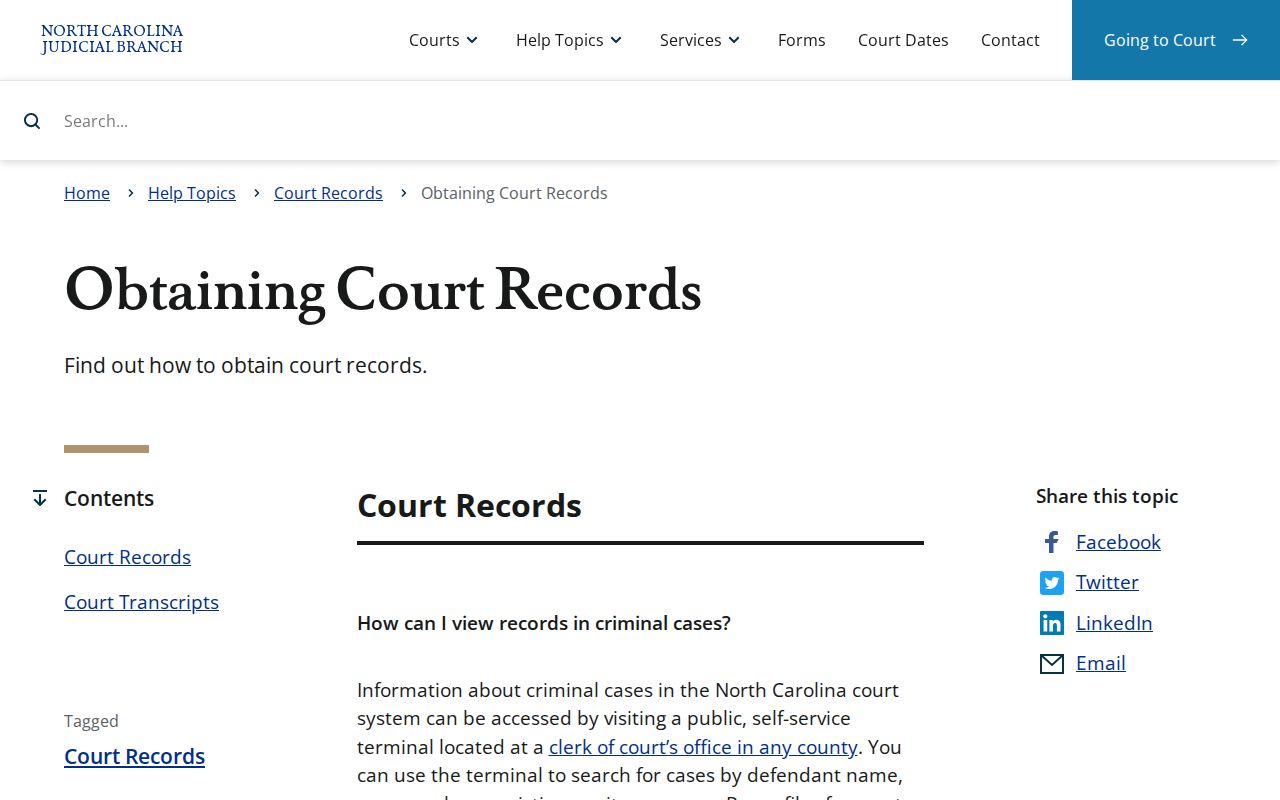
North Carolina’s Judicial Branch explains the official court-record route:
Why Alleghany Releases Stay Offline
Alleghany’s official Sheriff page contains no roster or recent-release archive, so there is no documented 72-hour visibility window, cadence, or retention rule. This lack of a web feature is a local fact, not a temporary blank result. The correct chain is present detention status, the Records release summary, and court corroboration.
Record retention must also be separated from website display. The North Carolina sheriff schedule includes entry and release summaries and release orders among inmate incarceration records and permits destruction three years after release or transfer, subject to audit or litigation needs. An agency may retain a document even though it never posts the document online. The schedule does not guarantee public access to every field without review or redaction.
A three-day request should name the beginning and ending dates, not merely say “recent.” Include the facility and a booking or case number if known. When the period crosses midnight, a weekend, or a holiday, ask for the actual event timestamp and release authority. This keeps a court-order date from being mistaken for the later physical movement and gives Records enough detail to locate an entry that may fall just outside the expected calendar day.
Alleghany Release Court Trail
Alleghany County is in Judicial District 34. North Carolina’s statewide eCourts environment can expose public case information, and clerk offices have public self-service terminals. The Alleghany court contact directory routes readers to the clerk and magistrate. Search by defendant or case number and review the newest order, disposition, judgment, sentence, and jail-credit notation. The Alleghany County Clerk maintains the local paper file.
The court record explains legal authority. It may show dismissal, a sentence of time served, a prison judgment, or pretrial conditions. The jail record answers a separate operational question: when did physical custody at 40 Alleghany Street end? A prison judgment may explain a transfer to NC DAC instead of community release.
District 34’s bail policy also uses suggested ranges rather than a rigid schedule. Judicial officials individualize conditions. Even after those conditions are met, processing and other holds can delay or redirect movement. Do not calculate an exit time from the bond order.
Alleghany Release Status Alternatives
NC SAVAN and VINELink provide a person-specific status and alert channel for participating North Carolina jail and Adult Correction records. Choose North Carolina, compare identity and reporting agency, and register for an available status change if the person is still held. A local jail ID and a DAC offender number are different, and transfer can require another registration. A no-result does not mean release.
Use NC DAC Offender Public Information only when state prison or state supervision is plausible. The Inmate Release Search can filter state releases by county and month, but it is not Alleghany’s missing three-day jail list. “Alleghany” in a state county field may refer to conviction or release coding and does not prove a departure from the Sparta jail. An actual movement entry is stronger than a projected date.
Federal and immigration custody require separate tools. BOP’s locator covers federal records from 1982 forward. ICE’s locator can include current detainees and people released from ICE custody within the preceding 60 days. Neither confirms an ordinary county release. A local transfer to another authority ends Alleghany’s physical custody but may continue confinement elsewhere.
Alleghany Release Versus Transfer
“Released from Alleghany County” can mean the local jail no longer holds the person. It does not always mean the person returned to the community. A transfer destination or receiving authority, when recorded and public, resolves much of that ambiguity. Follow the receiving agency rather than continuing to search a missing county feed.
For a true community release, the jail entry should supply the event time and reason or authority. The court file may explain the basis, while VINELink may have carried an alert. For continued state custody, OPI should eventually reflect the DAC stage. For a same-day focus instead of the broader records span, the Released Last 24 Hours guide narrows the workflow.
The strongest confirmation hierarchy is the Sheriff’s actual release record, direct current jail status, the court order or disposition, a participating VINE event, and then the receiving custodian. Private screenshots sit below those official sources and should be treated only as leads.
The NC Sex Offender and Public Protection Registry can be consulted only when registration is legally relevant. It can show a qualifying registrant after release, but it is not a countywide three-day list and does not establish when jail custody ended. A person who is not required to register will not be found there, so absence has no meaning for the wider jail search.
For older records, timing still matters. The county retention schedule creates a practical request window for incarceration files, while the court file may remain the more durable explanation of the order or judgment. State OPI separately advertises historical DAC information back to 1972, but that history excludes county-only jail stays. Choose the archive that created the event instead of treating one database as universal.