
Alleghany Mugshots and Public Records
A booking photo documents appearance during a particular law-enforcement process. G.S. 15A-502 authorizes law-enforcement photographs and fingerprints. North Carolina Chapter 132 broadly includes photographs within its record definition, but that does not make every mugshot automatically and unconditionally public. G.S. 132-1.4 treats criminal-investigation records differently while identifying public arrest information.
The useful approach is to request the exact Alleghany County image and let the records custodian apply any lawful exception or redaction. The administrative booking or incarceration record should be distinguished from investigative notes. If all or part of the item is withheld, ask the Sheriff's Records Unit to identify the legal basis. Do not turn the general public-record definition into a promise that a specific photograph will be released.
A person generally drops off a current custody display after release, but the underlying arrest and booking records may be retained. The county sheriff records schedule recognizes entry and release records and allows destruction three years after release or transfer absent an audit or litigation hold. Retention does not guarantee public access, nor does it describe an online display period. Alleghany County publishes no photo-display period because it publishes no official photo feed.
Where Alleghany Released Mugshots Appear
Start with the record system tied to the event. A county booking photo and a state correction image are not substitutes for one another. VINELink is built for status and notice, not as an archive of booking images. The registry has a photo rule only for people legally required to register. Commercial databases and old news pages may persist, but neither should be treated as the official keeper of the release record.
| Channel | Photo availability | How to use it |
|---|---|---|
| Alleghany Sheriff web | No official roster or photo gallery located | Do not claim an online photo, release window, or retention period |
| Sheriff mobile app | No official Alleghany County, NC app located | Avoid similarly named apps from other states |
| County records request | Request the booking photograph by name | Supply the booking or case details and accept lawful redaction or denial |
| NC DAC OPI | State records may display an identifying image | Use only for DAC prison or supervision, not the county booking photo |
| NC public registry | Photo for qualifying public registrants | Check legal relevance and status; it is not a release-date source |
| VINELink | Depends on interface and agency feed | Use for identity, custody status, and alerts, not a photo archive |
| News and commercial sources | A prior image may remain | Treat it only as a lead and verify the event and later case outcome officially |
For a released county detainee, the Alleghany records request is the direct official route. For a person who entered state prison, OPI can be relevant, though the state image belongs to the DAC record. A current jail roster would be the wrong tool for a released person even if one existed. The Alleghany County named-person release guide explains how the jail, court, DAC, and other systems establish custody history.
Avoid the Alleghany Mugshot Mix-Up
No official Alleghany County, North Carolina sheriff app or online booking-photo feed was found. This absence is a distinctive local fact. Search results often point instead to Maryland products for “Allegany County” or to Alleghany Regional Jail in Virginia. Those pages can contain real photographs and names from a different facility, which makes a wrong-jurisdiction match look plausible.
Verify the state and spelling before accepting any image. The relevant North Carolina jail is the Alleghany County Detention Center at 40 Alleghany Street in Sparta. Its Detention number uses the 336 area code, as does the Sheriff's Records Unit. An app labeled for Allegany County, or a result naming the Virginia regional jail, is not an alternate portal for the Sparta facility.
The Alleghany County last-24-hours page documents the same lack of an official recent-release feed. The lack of a web photo does not prove that no booking photograph exists. It means the image must be requested from the proper custodian rather than copied from a look-alike jurisdiction.
Note: Confirm “Alleghany County, North Carolina,” the Sparta address, and the 336 area code before matching any booking photograph.
Request an Alleghany Booking Photo
Alleghany County provides a signed Public Records Request Form. It may be filled electronically but requires a physical signature. The form can be submitted in person, emailed to recordsrequest@alleghanycounty-nc.gov, or mailed to Alleghany County Records Request, PO Box 366, Sparta, NC 28675. It asks for requester and contact details, the holding department, a record description, delivery by mail, email, or pickup, and whether the requester represents media.
- Confirm the person’s full name and approximate booking dates.
- Add the booking or court case number when known to reduce mistaken identity.
- Name the Alleghany County Sheriff's Office or Detention Center as the likely custodian.
- Request “the booking photograph” as a separate item rather than assuming it comes with the release summary.
- Describe the arrest or booking date range and the related release or transfer event.
- Choose the form's delivery method, sign it, and submit through an official county channel.
- If material is withheld or redacted, ask for the statute supporting that decision.
The county form states no fixed fee and promises no fixed completion time. Do not add one. Narrow dates and an exact item help the custodian identify the record. A useful request can also ask for the entry or release summary, actual release date and time, release code or authority, and receiving agency if recorded and public. Those fields connect the image to a custody event without implying what the photo itself proves.
North Carolina's criminal-investigation and arrest-information statute shows why a photograph request needs a record-specific response.
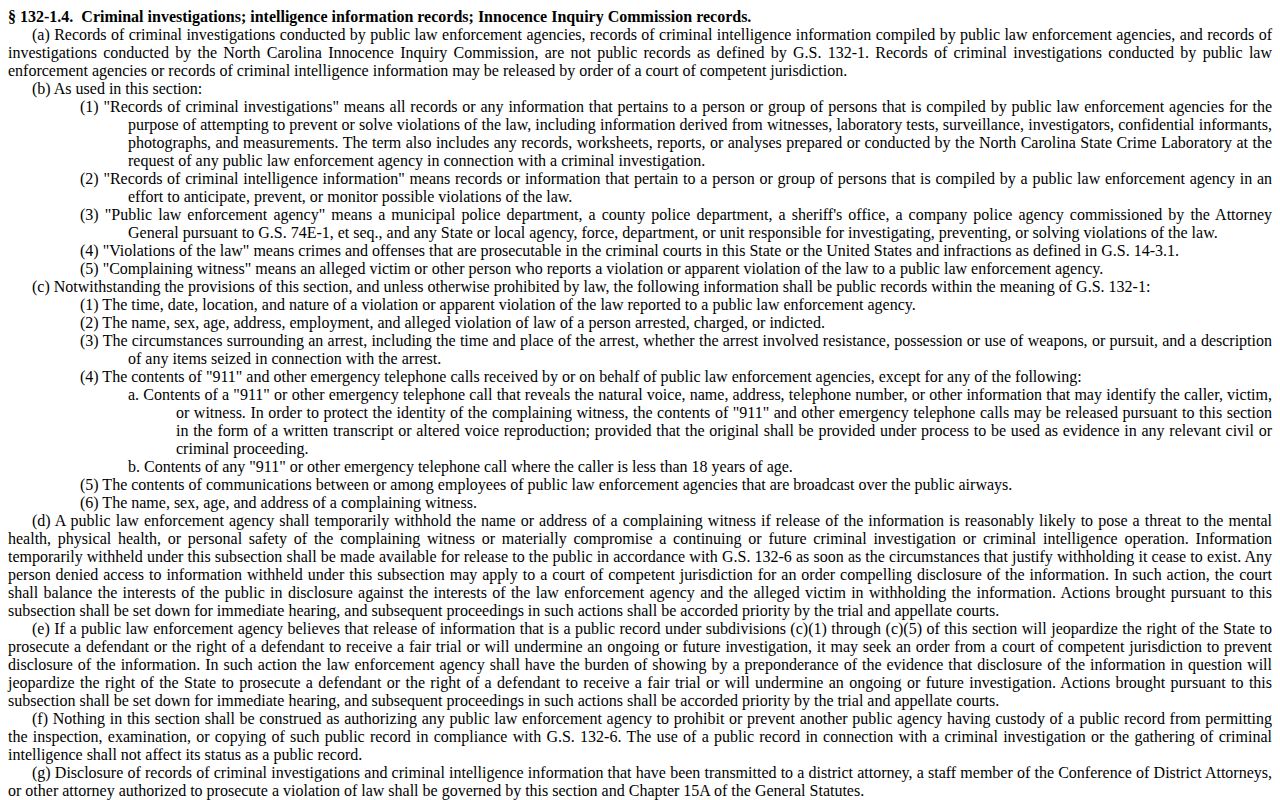
The official statute frames the custodian's review; the county's response determines what is available for the specific Alleghany booking.
State Photos Are Not Alleghany Bookings
NC DAC Offender Public Information may include identifying information and an image in its public presentation. Its scope is state prison and community supervision. DAC expressly excludes county-jail information, so an OPI image is not the Alleghany County booking photograph unless the records happen to derive from different events involving the same person. Read the state record for current or historical DAC status, sentence, admission, projected date, and movement fields.
The NC Sex Offender and Public Protection Registry is narrower still. G.S. 14-208.15 affirmatively provides public Internet access and sheriff-supplied photographs for qualifying registrants. That photograph may be current and official, but it applies only when registration law is relevant. Registry presence does not supply a jail-release date. Absence says nothing about a person who has no duty to register.
The official registry guidance helps define that limited purpose.
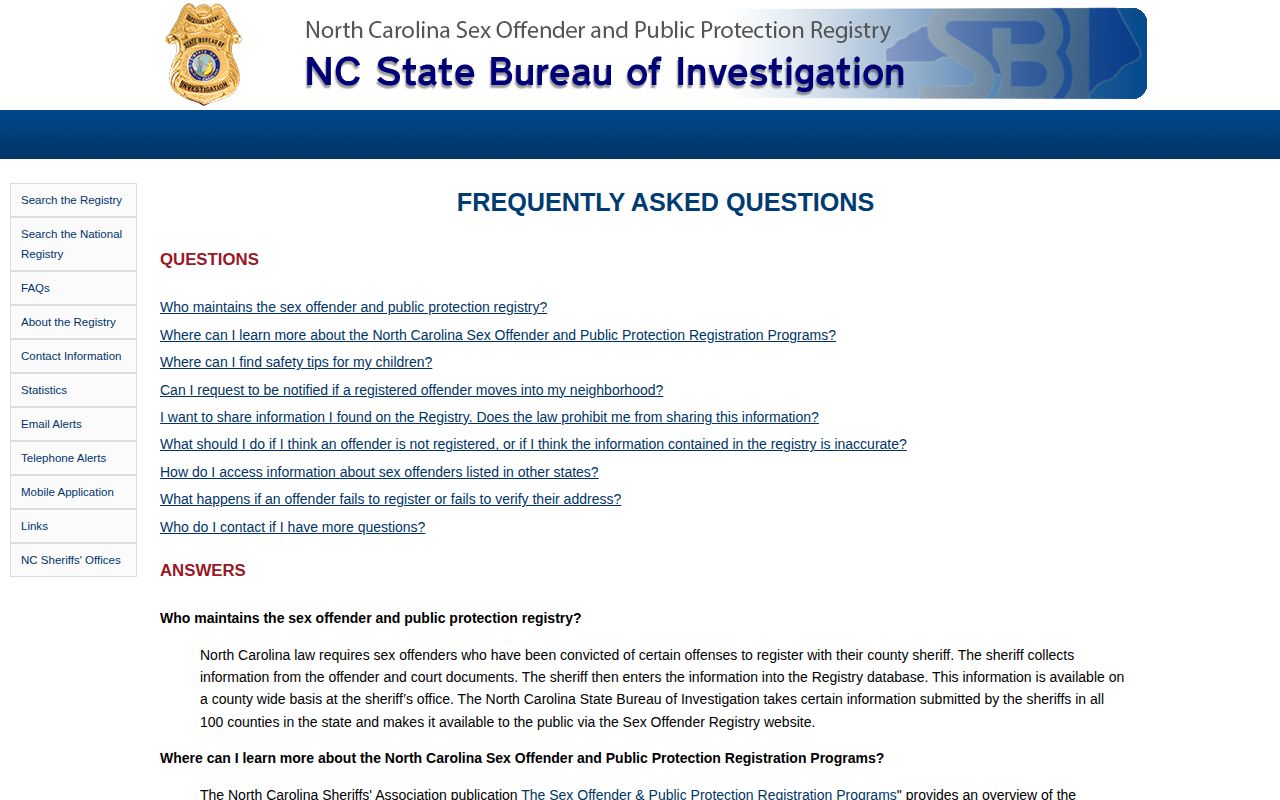
The registry must be read according to its own status fields and cannot be expanded into a general Alleghany released-inmate photo search.
Context for Alleghany Released Mugshots
A photograph can outlive the custody event that created it. A news report may retain an arrest image after dismissal, acquittal, a completed sentence, or expunction. A commercial page may use an old image, misstate the jurisdiction, or fail to reflect a later court result. Those channels should be treated as categories only. They receive no official standing, no recommendation, and no link from this records reference.
Match the image to the durable Alleghany court case. North Carolina's statewide eCourts environment and the Clerk of Superior Court can supply public case information. Review the most recent order, disposition, judgment, sentence, and custody credit. A booking photo does not show that outcome. It also does not establish whether the person is now free, held on another matter, or under state community supervision.
VINELink has a different role. It can identify a participating record and offer status-change notifications. It is not a county mugshot archive. A released result should be confirmed through the named agency's record, and a transfer alert should not be described as community release. Keeping image discovery separate from custody confirmation prevents an old photograph from being mistaken for current status.
The county sheriff retention schedule gives a practical record-search window but no web guarantee. It recognizes active and inactive inmate incarceration records, including arrest sheets, entry or release summaries, commitment and release orders, work-release records, and pretrial-release agreements. Destruction is authorized three years after release or transfer unless an audit or litigation concern requires longer retention. The rule does not promise that every photograph accompanies every summary, that every item is open without redaction, or that the image remained online.
State records operate differently. OPI advertises historical correction information back to 1972, while state storage schedules address custody files held by the agency. A long-lived OPI entry cannot be used to predict whether the Alleghany Sheriff's separate photograph still exists. Ask each custodian only for the image and event it controls, and do not use one agency's retention practice to fill a gap in another's response.
Expunction and Mugshot Availability
North Carolina's Judicial Branch describes expunction as a legal process that removes a conviction or charge and seals or destroys state arrest, charge, and conviction records. The petition generally goes to the clerk in the county of charge or conviction. Eligibility, forms, procedure, and effects depend on the governing statute. A later gap in ordinary court access should not be used to invent a case history or claim that no arrest occurred.
An expunction can affect official discoverability, but a copy held elsewhere raises a source-specific question. Ask the official agency that controls the image what order or documentation it needs and follow the court's process. There is no verified enacted North Carolina anti-pay-to-remove mugshot statute in the official research. Proposed legislation must not be presented as current law. Paying a commercial publisher is not an official correction or release-record process and is not recommended.
The Judicial Branch notes that an expunction petition generally belongs with the clerk in the county of charge or conviction and can take months to process. Forms and eligibility depend on the governing statute. In a qualifying later inquiry, an AOC certificate may verify that an expunction occurred even after files are destroyed. None of these facts allows an old photo to be assigned a new meaning. The official order and the response of the image custodian control what can still be found through government channels.
Public-record and use limit. This site is not a consumer reporting agency under the FCRA, and mugshot information may not be used for any FCRA-covered purpose.
A supported official response may release, redact, or withhold the requested item. Preserve that response, the cited authority, and the related court disposition. The most reliable Alleghany County photo record is one tied to the right booking and read beside the complete later case, not an image detached from its source.